Monday, January 21, 2013

A Greater Good

Yesterday in Sunday School, our teacher, a doctor, shared a story about a young man who was ready to serve a mission.  As a child, the young man suffered from a condition that in most people doesn't go away, but it did for him.  Because the condition was gone, the young man wondered if he should indicate that he'd had that condition as a child.  The doctor counseled him to be completely honest in his mission application and indicate that yes, he'd had this condition.

The young man was concerned that if he indicated the past condition, he might be limited in where he could serve.  The doctor offered to write a letter explaining the health situation and clarifying that the young man was capable of serving without restrictions.

The mission papers were sent in, and the young man waited and waited for his call.  After several weeks, I believe the family asked the doctor to intervene and see if he could find out what the hang-up was.  After some sleuthing, they found that the doctor's letter had been overlooked and there was indeed some concern about where to send this young man because of his (past) condition.  Things were cleared up and the young man is now on track to receive a call.

Throughout the story, you could tell the doctor-teacher was really frustrated with the process of the missionary application in regards to health records.  I wondered if that was his big annoyance with Church structure.  I could tell he wanted a better system in place.

Last night, I recollected yesterday's post regarding "Mormon feminists" and thought about the things that bug them most about the Church.  I mentioned to my husband that everyone really does have their own "thing," don't they?  He kind of laughed and said he, of course, being a programmer is rather bothered by the technical issues he sees in the Church software and web sites.  Our conversation reminded him of some study he'd been doing on the Constitution earlier in the day regarding sacrificing for the greater good.  He'd run across this quote from Benjamin Franklin in a talk by Dallin H. Oaks that I think is worth sharing:
When you assemble a number of men to have the advantage over their joint wisdom, you inevitably assemble with those men, all their prejudices, their passions, their errors of opinion, their local interests, and their selfish views. From such an assembly can a perfect production be expected? It therefore astonishes me, Sir, to find this system approaching so near to perfection as it does. … The opinions I have had of its errors, I sacrifice to the public good.
And then Dallin H. Oaks summarizes,
In other words, one should not expect perfection—one certainly should not expect all of his personal preferences—in a document that must represent a consensus. One should not sulk over a representative body’s failure to attain perfection. Americans are well advised to support the best that can be obtained in the circumstances that prevail. That is sound advice not only for the drafting of a constitution but also for the adoption and administration of laws under it.  --The Divinely Inspired Constitution, Dallin H. Oaks, Ensign Feb 1992
Although this is about the Constitution, the principle of sacrificing personal interests for the greater, or public good is a nice reminder to let go of the hang-ups we may have with Church processes.  There's always a bigger picture than what we see, and although something that may bother us may seem huge, there are probably 100 other issues that bother other people that are also just as important.

Sunday, January 20, 2013

Who Holds the Power?

I know this is a way old topic now, but within a day or so of hearing about the whole "pants" episode, I went to do my nightly scripture reading and happened to be on 3 Nephi 14.  The words in verses 13-23 flew out at me like a 3-D movie:
Enter ye in at the strait gate; for wide is the gate, and broad is the way, which leadeth to destruction, and many there be who go in thereat; Because strait is the gate, and narrow is the way, which leadeth unto life, and few there be that find it.
Beware of false prophets, who come to you in sheep’s clothing, but inwardly they are ravening wolves.  Ye shall know them by their fruits.
Do men gather grapes of thorns, or figs of thistles?  Even so every good tree bringeth forth good fruit; but a corrupt tree bringeth forth evil fruit.  A good tree cannot bring forth evil fruit, neither a corrupt tree bring forth good fruit.   Every tree that bringeth not forth good fruit is hewn down, and cast into the fire.  Wherefore, by their fruits ye shall know them.
Not every one that saith unto me, Lord, Lord, shall enter into the kingdom of heaven; but he that doeth the will of my Father who is in heaven.  Many will say to me in that day: Lord, Lord, have we not prophesied in thy name, and in thy name have cast out devils, and in thy name done many wonderful works?  And then will I profess unto them: I never knew you; departfrom me, ye that work iniquity.
After reading that, I felt it confirmed that supporting pants-type movements was not for me.  Now maybe some women have that "calling" to lead an participate in movements like this, but I'm not one of them.  

The other day I heard about the petition by the pants organizers to write letters to Church headquarters to ask the Church leaders to allow women to pray at General Conference.  I have nothing against women praying in General Conference; I think it would be great, but an organized movement to write letters?  Sorry, I think I'll stay away.  I believe the leaders of the Church are already aware of the praying discrepancy, and if it is supposed to change, it will.  I can't imagine that Church leaders are deliberately conspiring to hurt anyone in this situation, and I don't think a mass of letters coming their way is going to help things.
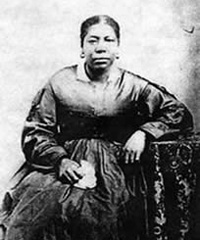
Image: Wikipedia
When Jane Manning James (a black pioneer woman) had concerns about her husband not holding the priesthood and about not being able to attend the temple, she DID question.  She even questioned the prophet, but she didn't gather up a band of people to petition for her cause (as far as I know).  She made it personal and plead for understanding in her own way.  I can't imagine the hurt she felt in her situation, but she did not cause a rebellion.

What concerns me the most is the premeditated organization behind these movements.  If there's a concerted effort to organize pants day, then letter-writing, what's next?  I also feel that by petitioning the Church for change, it implies that the power is in the Church itself, when really, isn't the power in us?  Aren't we the ones who can receive direct revelation for ourselves from God?  That does not require the Church.  What influence can I have on those around me?  It does not take the Church telling me what to do to serve others.  What is my personal ministry?  I find that out for myself.  The Church is just an institution to keep Christ's church orderly and to provide temples, meetinghouses, organized missionary work, and other great things. A sometimes imperfect Church structure does not need to cause me undue angst. I control my own microcosm.

Sunday, December 23, 2012

All Things Testify of Him

Image: lds.org

[Note:  If you'll be offended that we don't do Santa, you might not want to read this post.]

If you know me well, you probably know that we don't "do" Santa at our house.  However, this year, to not be so abrupt about it, I've tried to focus on Santa as being someone who reminds us to watch out for and care for others. So, every time we see a Santa, we try and think, what can we do for someone else?  How can we help?

This not doing Santa really has its pro's and con's for very much the same con's as doing that Elf on the Shelf.  One of the most difficult things about not doing Santa is trying to get our kids to not tell other kids, at least when they're little.  Although we've not emphasized Santa at all, the funny thing this year is that our three year old asks every day when Santa is coming.  Rather than saying he's not coming, I've been saying, "Christmas is in three days.  We'll get some presents then, but Santa reminds us to watch out for others."  Honestly, I don't appreciate that others have indoctrinated her with Santa, but I'm glad I can give her not such a disappointing answer that Santa's not real.

I realized the other day, though, a flaw in me telling her that Santa is a reminder to do nice things.  It's great he's a reminder, but why don't I just tell her to think of other people when she thinks of Jesus?  Simply put, we don't need Santa to remind us of that; Christ has already done it.  I guess it's not PC to dress up as Jesus and walk around town, though.  There's a reason it's called Christmas (Christ Mass => Christ Celebration) and not Santamas.

So, I'd love to not have to deal with Santa at all, but since I can't beat the Modern-day Commercial Santa Machine, I guess I'll just have to continue pushing the caring for others idea. As I pondered this, I realized there are A LOT of Christmas traditions that have nothing to do with Christ.  Ironically, we've attached new meanings to these ideas to take them back to Christ.  I'd prefer we use more stars, sheep, angels, shepherds, light, etc. to help us celebrate Christmas, but I suppose I can ditch my desire for historical accuracy and take these new symbols along with their invented stories to help remind me and my family of Christ.

Along with Santa Claus being a symbol of Christ, other invented symbols include,


Tonight we read "Teach the Children" from Especially for Mormons, Vol 2, a story about Santa going to someone's house pleading with the parent to teach the children the true meaning of Christmas.  Here are a few more ideas on how to integrate modern symbols into the the actual past.

  • Red ornament - first color of Christmas; reminds of blood of the Savior; greatest color of all; symbol of the gift of God.
  • Tree - deep green a perfect background for the red ornament; second color of Christmas; symbolizes everlasting hope of mankind; youthful, hopeful, abundant color of nature; needles point heavenward (man's return toward heaven).
  • Bell - reminder to return to the fold; guidance & return.
  • Candle - shows thanks for the star long ago; mirrors starlight
  • Bow - spirit of brotherhood of man; we should be tied with the bonds of good will
  • Wreath - eternal nature of love; continuous round of affection; reminds us of all the things of Christmas.
Some of the above symbols may actually be "real," but I haven't researched them yet.  For now I'll try to make these modern symbols also testify of Him, but I guess I'm just more of an Alonzo Gaskill kind of girl.

Saturday, December 15, 2012

The Part of Life We Call Death

Saying goodbye to mom

After the tragedy yesterday in Connecticut, of course my first reaction was to hide, keep my children inside forever, and even homeschool them.  I also again had the thought that is's a wonder that we actually live each day, rather than die.  I'm serious.  This will sound really pessimistic, but there are so many things that could kill us.  I think the first time I thought of that concept was a few years ago when I'd heard of some car accident.  Just the other day on the Today show there was a story about when someone is threatening to drive home drunk, most people let him or her.  Women protest it more than men, but in the end, the drunk drives.  In addition to the shooting, there was a stabbing of 22 children and their teacher in China yesterday. A couple weeks ago my not-yet-retired neighbor died of a massive heart attack.  He was healthy and fit.  Any one of us could get cancer or some other disease and die.  In so many ways, it's a miracle we're alive every day.

So how do we not fear death?  I think the first thing we need is an understanding of the Plan of Salvation and specifically that there is life after death; we need a testimony that we will live again.  We need to know that death is merely a passage to the other side, just as birth was a doorway to come here.  Perhaps we were just as nervous of birth before we experienced it as we are of death.  Maybe once we die, we'll realize it's not such a bad thing after all.  If we thought of death as a baptism where going down under the water might be a little bit scary, but coming up out of the water was the most beautiful cleansing thing, we might not be so fearful.

I'm again recommitted to teach my children the Gospel of Jesus Christ so that they will be prepared when their time comes.  I'm determined to help them not fear death, and as a mortician's wife once told me, to make it a part of life.

Thursday, December 6, 2012

The State of Working-Class Men

I almost just "pinned" this, but thought I'd better save a few of the quotes from The No Good, Very Bad Outlook for the Working-Class American Man:


  • Work, for men, means more than money: It connects them to their communities, makes them more attractive as mates and more successful as spouses, and is a linchpin of their self-esteem. When they don’t work, their role in the community tends to wither, harming the places where they live as well as themselves. Their family lives suffer, too. More and more often, less-educated men are strangers to marriage.
  • Both men and women have suffered from the disappearance of well-paying mid-skilled jobs in factories and offices. But they have responded very differently. “Women have been up-skilling very rapidly,” said MIT’s Autor, “whereas men have been much, much less successful in adapting.” Women have responded to the labor market’s increased preference for brains over brawn by streaming through college and into the workforce—one of the great successes of the U.S. economy. Men’s rate of completing college has barely budged since the late 1970s.
  • To women, men who either can’t or don’t earn a decent living are less necessary and desirable as mates; they’re just another mouth to feed. This helps to explain why rates of out-of-wedlock childbirth have risen to hitherto unimaginable heights among the less educated. Causality also flows in the opposite direction. The very fact of being married brings men a premium in their earnings, research shows, and makes them steadier workers, presumably because they have more stability at home. “Marriage is an institution that makes men more responsible in their pursuit of work and in their work-related duties,”
  • Low-earning men are decreasingly able to form stable families. That, in turn, harms their children and communities. “Social capital disintegrates as you have a combination of drop in participation in the labor force and the disintegration of marriage,
  • In 1970, more than three-fourths of men, no matter how much they earned, had wives; men at the bottom of the earnings scale were only slightly more likely to be single than were men at the top. Today, nearly half of the low-earning men are single, versus only a seventh of highly paid men.
  • Family structure, in short, has become both a leading cause and a primary casualty of an emerging class divide. At the top are families with two married earners, two college degrees, and kids who never question that their future includes a college degree and a good job; at the bottom, families with one (female) earner, no college, no marriage, and kids who grow up isolated from the world of work and higher education. And the two worlds are drifting apart.


This is really sobering, not just the economic side of it, but what it's doing to the family.

Monday, November 26, 2012

Altruism

Photo: Slate

We recently watched part one of Atlas Shrugged on Netflix.  I noticed afterward that there was a related  program entitled Ayn Rand and the Prophecy of Atlas Shrugged and thought that might also be interesting.  I started watching it and was fascinated by Rand's life and the background of her writings.  As I watched, I found myself being convinced that individuals should be equal, and that one individual shouldn't have to sacrifice for the comfort of others.  I was buying into the idea that alturism was bad.

Then it hit me as I recalled getting up at 6:00 each morning with the baby, being bitten while nursing, cooking, cooking, cleaning, and cleaning, that individual equality -- equal give and take -- is not like that at all in a family, especially a young one.  I don't think a family could function if everything were equal.  My kids and house would be a wreck if I didn't disregard my personal comfort and take care of them.  We'd also be destitute if my husband didn't personally sacrifice "his" income for the benefit of the family.

So, it's nice in theory that we should all be equal, and it should be possible with adults, but with a family, altruism must rule or the family falls apart.


Tuesday, November 13, 2012

Half the Sky

Last night my husband and I finished watching Half the Sky on Netflix.  Although in college (in the mid 1990s at BYU) I studied the topics presented in the film, I was heartbroken that some things are still so awful for some women.  I was especially struck with the beautiful faces that were put with the horrible stories; I couldn't believe that these children of God have such terrible experiences.

The film addresses six topics and their impact on, or how they're related to, women -- mainly in Asia and Africa.

1.  Rape
2.  Sex Trafficking (sex slavery)
3.  Education
4.  Maternal Mortality/Female Genital Cutting
5.  Intergenerational Prostitution
6.  Microcredit

As I watched the film, I couldn't but think of some of the parallels to our own country 150 years ago.  For example, some women TODAY have a 1:12 childbirth mortality rate.  If I remember correctly around the time of the Civil War in our country, it was 1:8 (I need to pull out the book at my mom's house that the statistic is in -- I could be wrong).  The mortality rate of a soldier was 1:20.  Can you believe your chances of survival were better as a soldier than as a woman?

Also, as mentioned in the film, males are more educated because traditional female work is more needed in the home.  The girls themselves may not be very valued, yet their care of the children and household is, so they parents keep their girls home.  Is that not the same way it was in our country a century and a half ago?  Additionally, some men don't want an educated wife, so if a girl is educated, she limits her opportunity for marriage.  I loved one quote in the film:  "Being smart lasts a lot longer than being pretty."


[graphic] The portion of the video that was completely infuriating was female genital mutilation.  Apparently, most men do not want to marry a woman who is "uncircumcised," and women who are not cut are considered unruly.  If an uncircumcised women bears a child, the child will be killed.  Not only is there an immediate risk to this practice (infection) which is done around ages 7-13?, but it interferes with childbirth.  Scar tissue is not at stretchy as un-scarred flesh and sometimes will create an obstruction to an imminent birth!  If the women happen to be in a hospital and this occurs, medical personnel can't even give a C-section without the approval of the husband, and many women and babies are lost.

[graphic] I did not know exactly what was done in a "female circumcision" and I don't care to describe it here, but you can liken it to having a mole on one's nose.  You could leave it there and not worry about it, or if you are a male in this comparison, you would cut just the mole off.  If you are a female, however, you wouldn't just remove the mole, you would remove the entire nose and stitch up the area leaving just a small opening at the bottom to let air in and mucous out.  You would not be able to experience the pleasure of smell anymore.

My husband found it interesting that to be considered marriageable, a woman had to be cut.  You could say that in that culture, it makes her more "attractive" to men.  How ironic that women in our own country feel that they, too, have to alter their appearance through breast implants, tummy tucks, and other surgeries to be attractive to men.  Really, is it that different in that regard?

It was apparent in the film that there is major conflict between and there are major discrepancies in the rights of men and women all over the world.  What I still wondered, though, was what are the feelings from one woman to another?  Do they generally look at each other as equals (equally lower class?), or is there a looking down upon one another, too?  When I did my student teaching in Western Samoa, I realized that there is quite a bond between siblings, yet not that connection from child to parent.  I believe it was because it was common for a parent to beat a child and assumed children did not want a close bond with someone who beat them?  If women are such the underdog, do they stick together?

I felt the film did a good job respecting differences in culture and not judging individuals.  I don't think after an interview, the interviewee felt he/she was made the bad guy (even when his/her life choices were obviously opposite the views of the film).  There were also a few remarks which implied the lack of respect for mothering/women's work in favor of careers and money.  Considering the circumstances, these women really could use the stability, yet I wouldn't want them to think of traditional women's work as a bad thing, either.

After studying and studying the LDS Church's Proclamation to the World on the family and trying to apply it to my life where I'm encouraged to be the primary nurturer and my husband is encouraged to provide and protect, I can see how the counsel can be even more beneficial in cultures where women are so marginalized.  The Proclamation clearly brings women and men to equal standing.  It encourages all to be educated.  It identifies women's and men's natural strengths and calls us to use those strengths together in raising a family.  It encourages us to kindly care for our children.

One of the last thoughts in the film was that like a bird, a family cannot fly if a wing is broken. I believe it was referring to the female half being broken, but I think you can also apply it to males.  If the men are not accepting of the women or are irresponsible for their spouse and offspring, then they are broken, too.  This is going to sound like a testimony meeting, but I must say that I am so grateful for the Gospel of Jesus Christ and living prophets who give us modern revelation on the family.  It is through this that we are empowered to be whole and complete.